Overview of antivenom allocation and use for snakebites in the Brazilian Amazon

  Overview of antivenom allocation and use for snakebites in the Brazilian Amazon Abstract Venomous snakebites affect many people in the Amazon annually. We analyzed the dynamics of the allocation and use of antivenoms in the Brazilian Amazon between 2010 and 2024. Of the 1,304,681 vials allocated to the region, 945,578 (72.5%) were administered, the majority of which were Bothrops antivenom (735,516 vials). The high level of actual antivenom use underscores the significance of this region regarding demand for antivenom treatment in Brazil. Martins, J. G., Pardal, P. P. D. O., & Procópio, R. E. D. L. (2027). Overview of antivenom allocation and use for snakebites in the Brazilian Amazon. Toxicon , 285 , 109347. https://doi.org/10.1016/j.toxicon.2026.109347

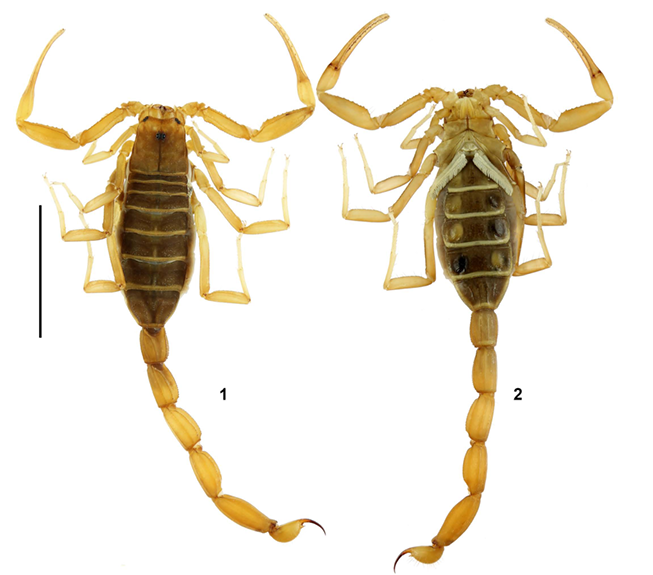
Scorpions of the Horn of Africa (Arachnida: Scorpiones). Part XXXII. Barbaracurus hofereki sp. n. from Djibouti


Scorpions of the Horn of Africa (Arachnida: Scorpiones). Part XXXII. Barbaracurus hofereki sp. n. from Djibouti

Abstract


Barbaracurus hofereki sp. n. from Djibouti is described and compared with other species of the genus. B. hofereki sp. n. is the only species of the genus with pedipalp movable finger with 8 rows of granules and pectinal tooth count 27–28 in female. Also, its pedipalp chela with very narrow manus (chela length/width ratio 6.07 in female), narrower than in all other African species of the genus. A map of the distribution of the genus in the Horn of Africa and the Arabian Peninsula is provided.


Kovařík, F. 2024 . Scorpions of the Horn of Africa (Arachnida: Scorpiones). Part XXXII. Barbaracurus hofereki sp. n. from Djibouti. Euscorpius, No. 387: 1-11. https://mds.marshall.edu/euscorpius/vol2024/iss387/1/