Testing the Limits of Morphology: A Comprehensive Morphometric Study of the Sister Lineages Lasiocyano Galleti-Lima, Hamilton, Borges and Guadanucci, 2023 and Lasiodora C. L. Koch, 1850 (Theraphosidae, Mygalomorphae)

  Testing the Limits of Morphology: A Comprehensive Morphometric Study of the Sister Lineages Lasiocyano Galleti-Lima, Hamilton, Borges and Guadanucci, 2023 and Lasiodora C. L. Koch, 1850 (Theraphosidae, Mygalomorphae) ABSTRACT Morphological conservatism and homoplasy pose significant challenges for the systematics of mygalomorph spiders, limiting the number of reliable morphological characters available for species identification, particularly in Theraphosidae. Closely related taxa frequently display high phenotypic similarity, which limits the resolution of morphology-based approaches. In this study, we conducted the most extensive morphometric analysis to date within Theraphosidae, with the objective of explicitly testing how much morphological information is retained within the  Lasiocyano sazimai  and  Lasiodora  lineage. We applied a morphometric framework combining linear morphometry and geometric morphometry, including multivariate statistics, discrimina...

Extinct scorpion family Chaerilobuthidae from Mid-Cretaceous Burmese amber reinterpreted as subfamily of extant family Pseudochactidae (Chelicerata: Scorpiones)


Extinct scorpion family Chaerilobuthidae from Mid-Cretaceous Burmese amber reinterpreted as subfamily of extant family Pseudochactidae (Chelicerata: Scorpiones)

Abstract

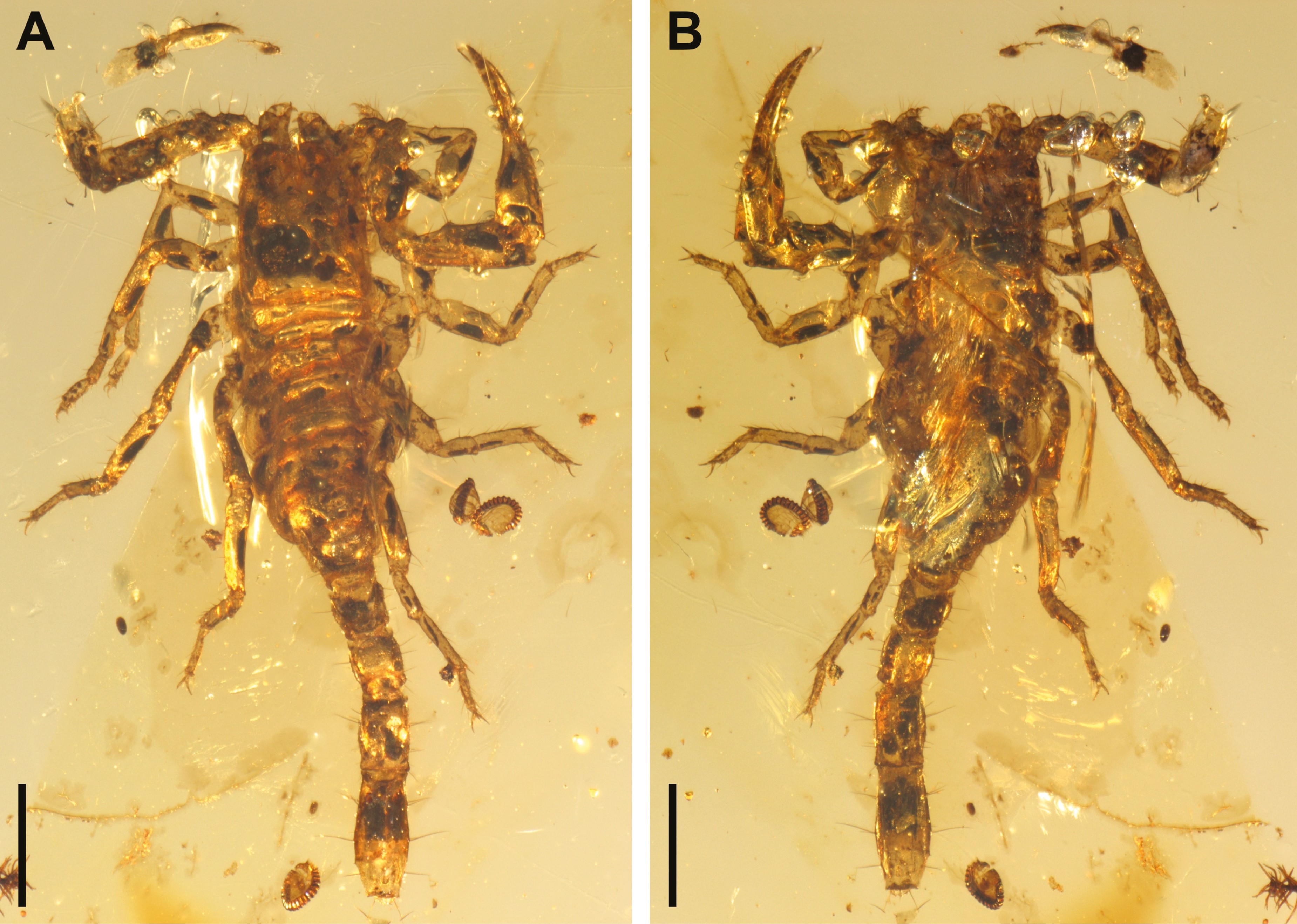
The extinct scorpion family Chaerilobuthidae Lourenço and Beigel, 2011, endemic to Burmese amber, was initially established due to its unique pedipalp trichobothrial pattern related to the Type A and Type B patterns of families Buthidae C.L. Koch, 1837 and Chaerilidae Pocock, 1893, respectively. The present contribution describes 11 new specimens, representing seven species of Chaerilobuthidae from Mid-Cretaceous Burmese amber, revealing their morphology using various imaging technologies. A revised diagnosis of Chaerilobuthus Lourenço and Beigel, 2011 is provided based on new morphological characters of the carapace, ocelli, chelicera, pedipalp trichobothria, coxapophyses, and leg tarsi. The other two genera of Chaerilobuthidae, Chaeriloiurus Lourenço, 2020 and Serratochaerilobuthus Lourenço, 2024, are synonymized with Chaerilobuthus based on a reassessment of their morphological characters and morphometric analysis, creating Chaerilobuthus brigittemuellerae (Lourenço and Velten, 2020), comb. nov. and Chaerilobuthus schmidti (Lourenço and Velten, 2024), comb. nov.. The systematic position of Chaerilobuthidae is clarified based on phylogenetic analyses of an updated morphological character matrix for Pseudochactidae Gromov, 1998, an extant family in Asia. Phylogenetic analysis placed Chaerilobuthidae sister to the pseudochactid subfamily Vietbocapinae Lourenço, 2012, justifying its transfer to Pseudochactidae, as Chaerilobuthinae Lourenço and Beigel, 2011, stat. nov.. This discovery confirms that Pseudochactidae date back 100 Mya and contributes to understanding the origin and evolutionary history of this relictual family. 

Qiang Xuan, Lorenzo Prendini, Michael S Engel, Chenyang Cai, Diying Huang, Extinct scorpion family Chaerilobuthidae from Mid-Cretaceous Burmese amber reinterpreted as subfamily of extant family Pseudochactidae (Chelicerata: Scorpiones), Zoological Journal of the Linnean Society, Volume 203, Issue 1, January 2025, zlae169, https://doi.org/10.1093/zoolinnean/zlae169