Scorpionism: a neglected tropical disease with global public health implications
Introduction
Scorpions are venomous arthropods belonging to the class Arachnida and the order Scorpiones (1). To date, ~2,772 species of scorpions have been described globally, of which around 104 species (3.8%) are considered of medical significance due to their venom toxicity and potential for severe envenomation (2). The majority of medically relevant species belong to the family Buthidae, which includes genera such as Androctonus, Buthus, Buthotus, Leiurus, Mesobuthus, and Parabuthus, found in regions such as Asia, India, the Middle East, and North Africa. Additionally, species from the Tityus genus are prevalent in South America and the Caribbean, while Centruroides species are commonly encountered in Mexico, Central America, and the southwestern United States (3).
Scorpion envenomation, or scorpionism, is recognized as a pressing yet often neglected public health concern, particularly in tropical and subtropical regions. It disproportionately affects rural and socioeconomically disadvantaged communities, where access to timely and adequate medical care is limited (4, 5). The presence of scorpions in human dwellings and workplaces leads to frequent encounters, thereby elevating the risk of envenomation and associated morbidity and mortality (6–8).
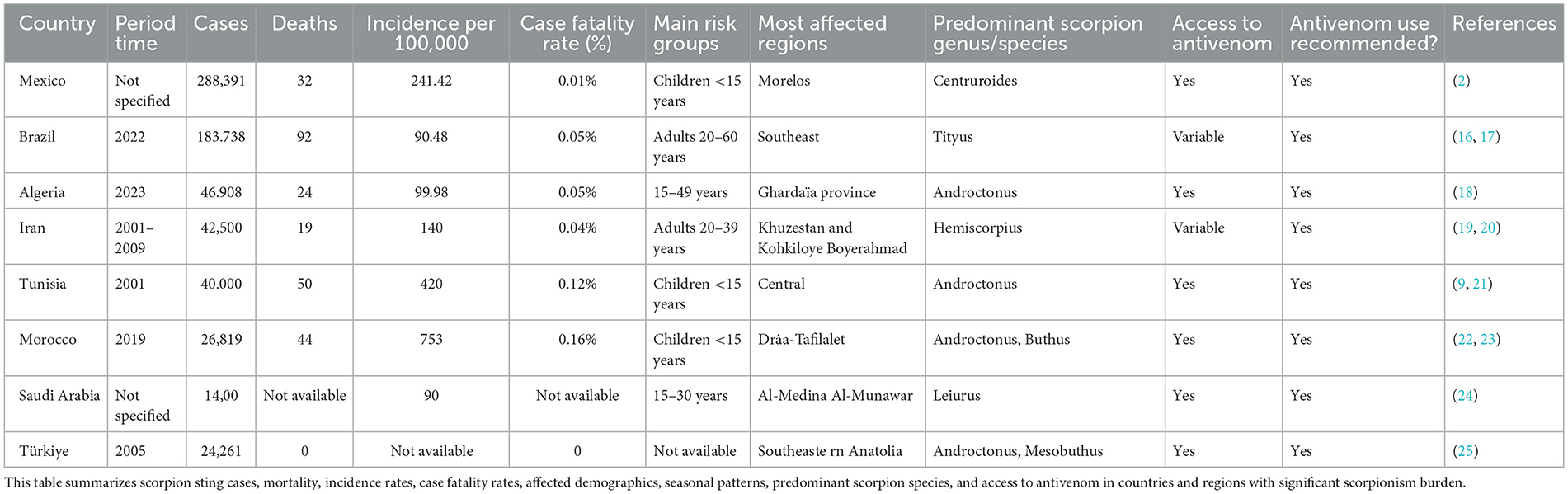
Global estimates suggest that over 1.2 million scorpion stings occur annually, resulting in more than 3,000 deaths, with a disproportionately high burden observed in children due to their lower body mass and increased vulnerability to systemic complications (9–11). Mortality is most prevalent in low-resource settings, where delayed access to antivenom and critical care services remains a major barrier. High-incidence countries include Mexico, Brazil, Iran, Algeria, and Morocco, where scorpionism remains endemic and requires targeted preventive and therapeutic strategies (12–15). Table 1 summarizes the number of reported cases, deaths, and incidence rates per 100,000 inhabitants in selected endemic countries and regions.
S., J. (2025). Scorpionism: A neglected tropical disease with global public health implications. Frontiers in Public Health, 13, 1603857. https://doi.org/10.3389/fpubh.2025.1603857