Climatic and density-dependent drivers of population dynamics in a hazardous urban scorpion species over seven years

  Climatic and density-dependent drivers of population dynamics in a hazardous urban scorpion species over seven years Abstract This link goes to a Portuguese section Tityus serrulatus Lutz & Mello (Scorpiones: Buthidae) is the most medically important scorpion in Brazil, responsible for a growing number of accidents in urban areas. Despite its relevance, the population dynamics of this species in anthropogenic habitats remain poorly understood, particularly regarding the influence of abiotic factors on its abundance and reproduction. We analysed long-term data (2006–2013) from T. serrulatus collected in an urban cemetery in the municipality of Americana, São Paulo State, Brazil. Using spatiotemporal mixed models, we evaluated the effects of temperature and humidity at the graves on the abundance of brooded and non-brooded individuals, as well as on the ratio between the two reproductive groups. A total of 21,489 individuals were recorded, including 463 brooded individuals. W...

Screening of antimicrobial activity in venom: Exploring key parameters


Screening of antimicrobial activity in venom: Exploring key parameters

Abstract

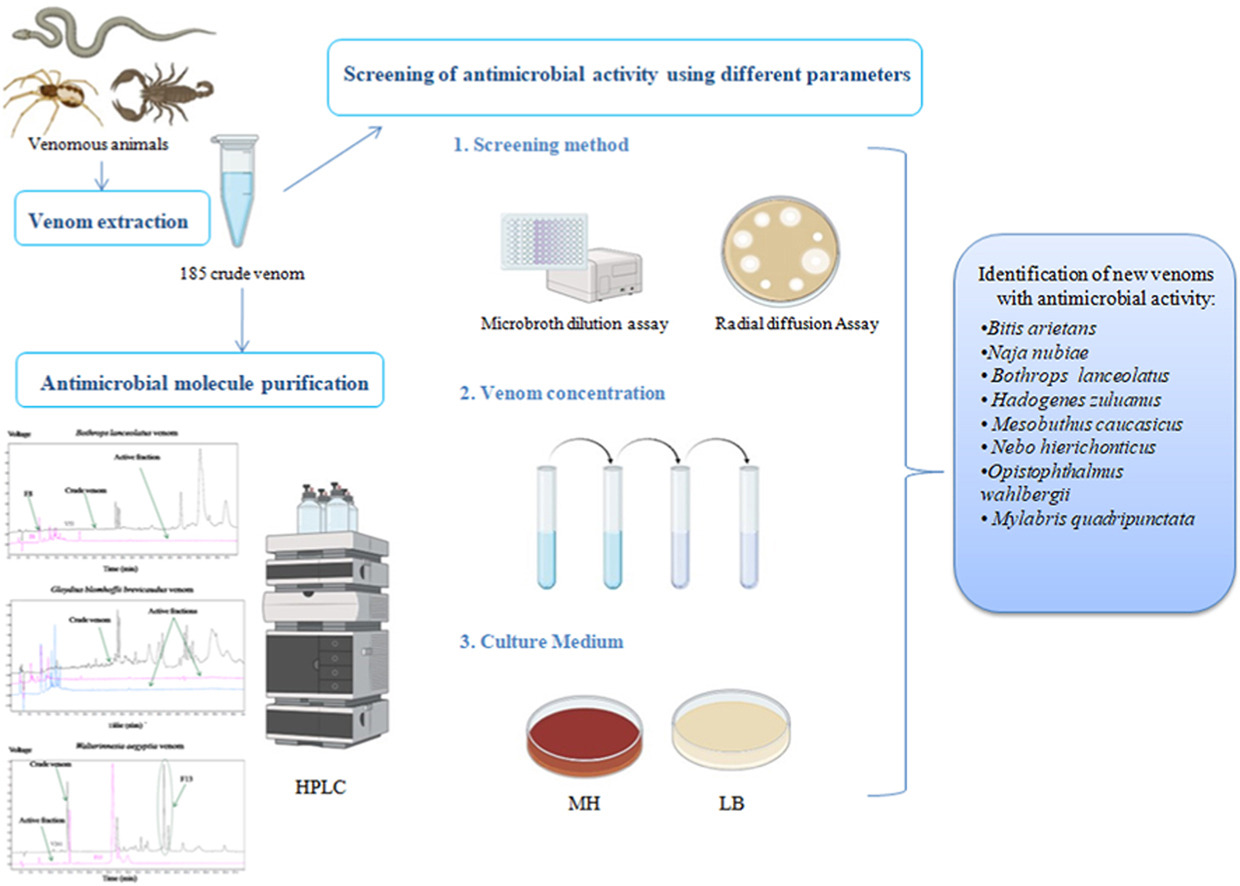
The escalating challenge of antibiotic resistance significantly threatens global health, underscoring the critical need for new antimicrobial agents. Venoms, increasingly recognized as reservoirs of bioactive compounds with diverse pharmacological effects, have been the focus of recent research. This work evaluates the use of various screening methodologies in assessing the antimicrobial activities of 185 venoms against some gram positive and gram negative bacteria, including E. coli ATCC 8739, B. subtilis ATCC 6633, P. aeruginosa ATCC 9027, and S. aureus ATCC 6538P species and explores the influence of settings on the findings. Furthermore, the research explored the possibility of purifying antimicrobial molecules from venoms through HPLC. Several fractions demonstrated antimicrobial activity against the tested strains.
Our results reveal that the measured antimicrobial efficacy of venoms varies according to:i) venom concentration, ii) the detection method, including microdilution and radial diffusion assays, and iii) the choice of culture medium, specifically LB or MH.
This strategy has allowed us, for the first time, to identify antimicrobial activity in: i) Bitis arietans venom against P. aeruginosa ATCC 9027, ii) Naja nubiae and Bothrops lanceolatus against B. subtilis ATCC 6633, P. aeruginosa ATCC 9027, and S. aureus ATCC 6538P, and iii) Hadogenes zuluanus, Mesobuthus caucasicus, Nebo hierichonticus, Opistophthalmus wahlbergii scorpions, and Mylabris quadripunctata beetles against S. aureus ATCC 6538P.
These findings highlight venoms potential as effective antimicrobial resources and improve our understanding of key factors critical for an accurate detection of venoms antimicrobial properties.
Ouertani, A., Mollet, C., Boughanmi, Y., De Pomyers, H., Mosbah, A., Ouzari, H., Cherif, A., Gigmes, D., Maresca, M., & Mabrouk, K. (2024). Screening of antimicrobial activity in venom: Exploring key parameters. Toxicon, 108135. https://doi.org/10.1016/j.toxicon.2024.108135