Phylogenetic relationships and ecological niche modeling of the widow spiders, genus Latrodectus Walckenaer, 1805 (Araneae: Theridiidae) in Iran

  Phylogenetic relationships and ecological niche modeling of the widow spiders, genus Latrodectus Walckenaer, 1805 (Araneae: Theridiidae) in Iran Abstract The genus Latrodectus Walckenaer, 1805, encompasses species commonly referred to as widow spiders, which display significant ecological diversity. A total of 35 morphological species within the genus Latrodectus have been identified and documented globally, with six species recognized in Iran: L. cinctus Blackwall, 1865; L. dahli Levi, 1959; L. geometricus C.L. Koch, 1841; L. pallidus O.P. Cambridge, 1872; L. revivensis Shulov, 1948; and L. tredecimguttatus (Rossi, 1790). This research employed statistical analysis to explore morphological variations and utilized molecular data to clarify the phylogenetic relationships within the genus Latrodectus in Iran. Furthermore, ecological niche models (ENMs) were constructed using maximum entropy modeling to predict the potential distribution of species identified in the country. Phyloge...

Three new species of genus Scorpiops Peters, 1861 from Tibet, China (Scorpiones: Scorpiopidae), with implications for the diagnostic values of qualitative characters


Three new species of genus Scorpiops Peters, 1861 from Tibet, China (Scorpiones: Scorpiopidae), with implications for the diagnostic values of qualitative characters

Abstract


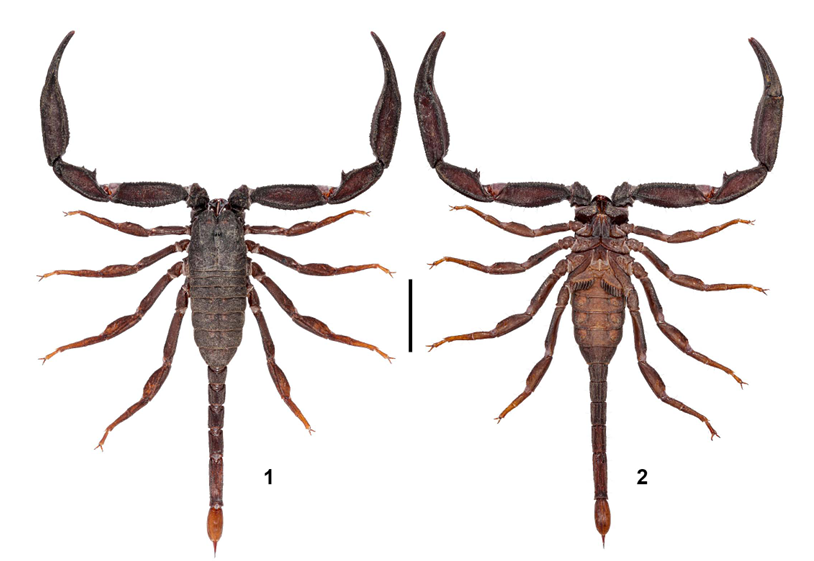
Three new species of genus Scorpiops Peters, 1861 are described from Tibet Autonomous Region, China. S. deshpandei sp. n. is described based on an adult male and an immature pair collected from Mêdog County, Nyingchi, with additional molecular evidence substantiating its validity against S. longimanus Pocock, 1893. S. kovariki sp. n. is featured by a single adult female from Zayü. This species is only weakly supported by its genetic distance from S. jendeki Kovařík, 1994, but empirical understanding of the morphological variation in Scorpiops species motivated us to consider them as distinct. S. matthewi sp. n. is based on three adult females, all collected from Xigazê. Its species delineation is based solely on morphological characteristics due to the lack of material of its morphological relative (S. rufus Lv & Di, 2023). New specimens of S. margerisonae Kovařík, 2000 are obtained from Nyêmo, Lhasa, and compared with S. wrzecionkoi Kovařík, 2020. A new term, “ocular islet”, is introduced to portray the periocular morphology of Scorpiops median ocelli, categorized into four preliminary types. Finally, a comparative matrix summarizing the quantitative and qualitative diagnostic characters of Tibetan Scorpiops species based on preceding publications is provided.


Tang, V., Ouyang, K., Liu, Z., & Šťáhlavský, F. 2024 . Three new species of genus Scorpiops Peters, 1861 from Tibet, China (Scorpiones: Scorpiopidae), with implications for the diagnostic values of qualitative characters. Euscorpius, No. 394: 1-40. 

https://mds.marshall.edu/euscorpius/vol2024/iss394/1/