The faunistic diversity of the spiders (Arachnida, Araneae) of the Waterberg District in the Limpopo Province of South Africa

  The faunistic diversity of the spiders ( Arachnida , Araneae ) of the Waterberg District in the Limpopo Province of South Africa Abstract The South African National Survey of Arachnida ( SANSA ) has conducted surveys in the Waterberg District of the Limpopo Province, South Africa, over more than 40 years. The first annotated checklist for the Waterberg District is provided here, along with the global distributions, endemicity and conservation assessments for each species, as per the International Union for Conservation of Nature ( IUCN ) criteria. A total of 54 families, 292 genera and 600 species were recorded. The study highlights species of special conservation concern, as well as the nine species endemic to the Waterberg District. Salticidae (95 species), followed by Thomisidae (80 species), Araneidae (53 species) and Gnaphosidae (48 species), are the most species-rich families. In contrast, single species represent 14 families. Most species (546; 91.2%) are widely distr...

Ecological niche modelling and thermal parameters to assess the prevalence of an endemic tarantula: the endurance of Grammostola vachoni Schiapelli & Gerschman, 1961


Ecological niche modelling and thermal parameters to assess the prevalence of an endemic tarantula: the endurance of Grammostola vachoni Schiapelli & Gerschman, 1961

Abstract

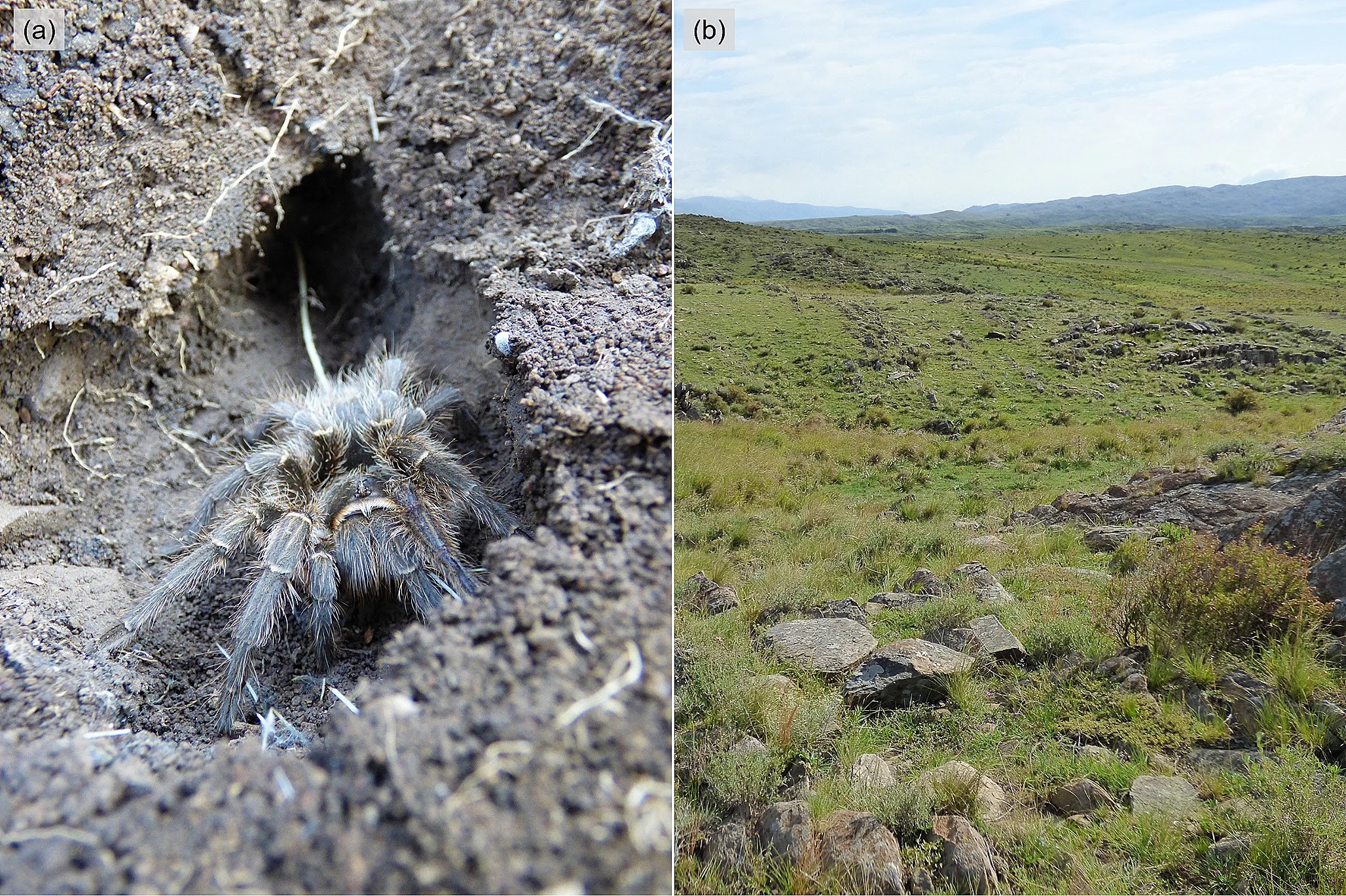
Environmental characteristics act as limiting factors for the establishment and survival of organisms, and this holds particular significance for ectothermic. Grammostola vachoni is an endemic Argentinean tarantula that inhabits central mountainous grasslands. In this study, we model their potential distribution and assess thermal parameters and vulnerability indices in unstudied populations to understand the species’ survival limits. The models to explain the geographic distribution of G. vachoni demonstrate a non-random pattern and robust predictive capabilities. The monthly variables in December, October, and March were the greatest influence. Respect to thermal parameters calculated throughout locomotor performance, the critical thermal limits were 4.9 °C and 51.1 °C, and the preferred temperatures were correlated whit optimal temperature. According the occurrence probability, the species has a low probability of persisting in extreme coldest and hottest environments. In a more temperate environment, the probability increases, mostly at temperatures of about 35 °C. The thermal performance breadth was 19.30, the thermal tolerance range was 46.1 °C and the inferior and superior limits of B80 were 18.9 °C and 37.1 °C. Grammostola vachoni show a better performance at higher temperatures, and a preference for higher temperatures than other ectotherms. The diverse microclimates provide by the heterogeneous nature of mountain grassland outcrops can act as a refuge.

Implications for insect conservation: Our results show that grassland outcrops play a key role in maintaining the G. vachoni population, as these environments appear to be less affected in the future. Moreover, the species’ locomotor performance could cope with future thermal shifts.

Schwerdt, L., de Villalobos, A.E. & Ferretti, N. Ecological niche modelling and thermal parameters to assess the prevalence of an endemic tarantula: the endurance of Grammostola vachoni Schiapelli & Gerschman, 1961. J Insect Conserv (2024). https://doi.org/10.1007/s10841-024-00595-y