Increasing Information Content and Diagnosability in Family-Level Classifications
Abstract
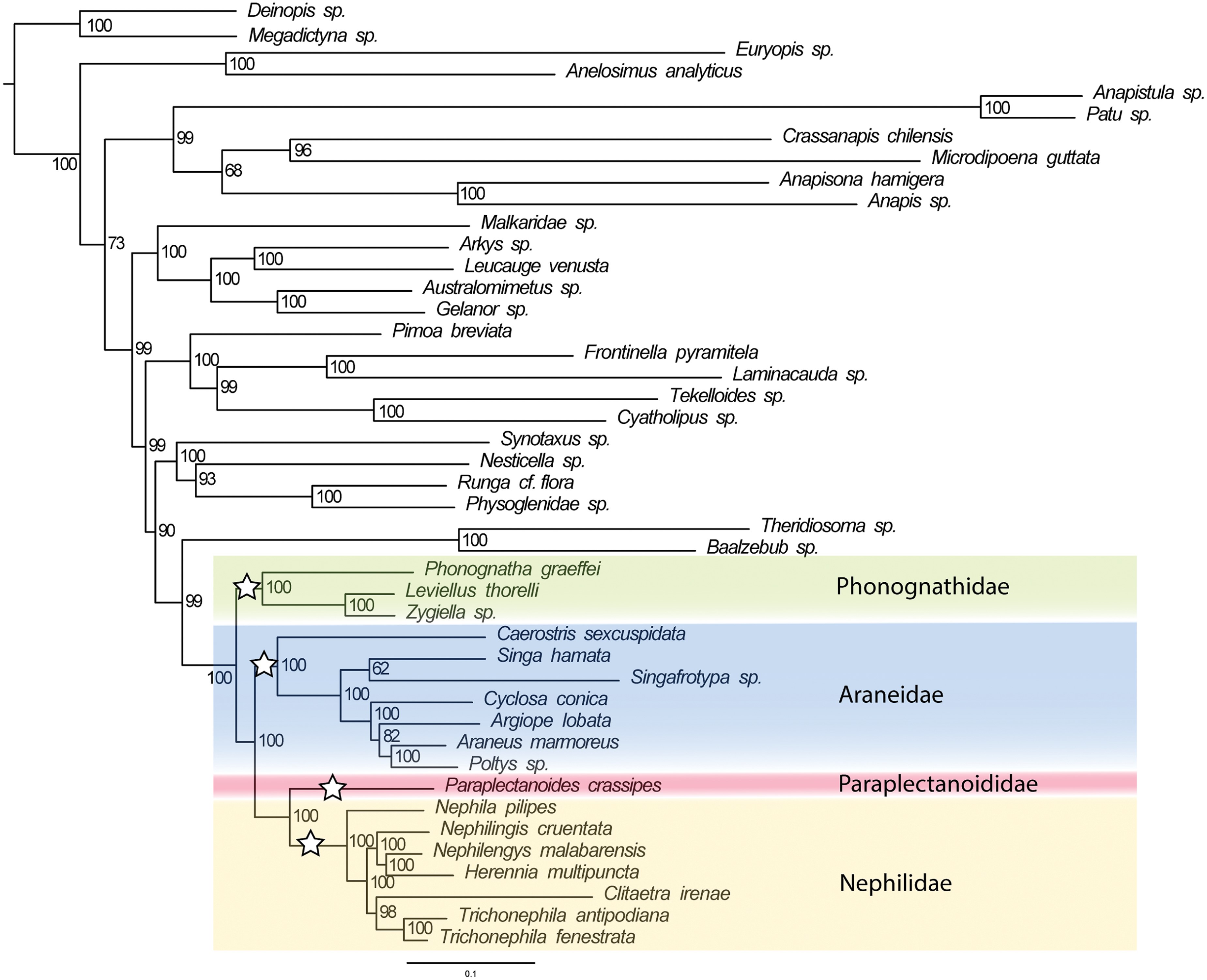
Higher-level classifications often must account for monotypic taxa representing depauperate evolutionary lineages and lacking synapomorphies of their better-known, well-defined sister clades. In a ranked (Linnean) or unranked (phylogenetic) classification system, discovering such a depauperate taxon does not necessarily invalidate the rank classification of sister clades. Named higher taxa must be monophyletic to be phylogenetically valid. Ranked taxa above the species level should also maximize information content, diagnosability, and utility (e.g., in biodiversity conservation). In spider classification, families are the highest rank that is systematically catalogued, and incertae sedis is not allowed. Consequently, it is important that family-level taxa be well defined and informative. We revisit the classification problem of Orbipurae, an unranked suprafamilial clade containing the spider families Nephilidae, Phonognathidae, and Araneidae sensu stricto. We argue that, to maximize diagnosability, information content, conservation utility, and practical taxonomic considerations, this “splitting” scheme is superior to its recently proposed alternative, which lumps these families together as Araneidae sensu lato. We propose to redefine Araneidae and recognize a monogeneric spider family, Paraplectanoididae fam. nov. to accommodate the depauperate lineage Paraplectanoides. We present new subgenomic data to stabilize Orbipurae topology which also supports our proposed family-level classification. Our example from spiders demonstrates why classifications must be able to accommodate depauperate evolutionary lineages, for example, Paraplectanoides. Finally, although clade age should not be a criterion to determine rank, other things being equal, comparable ages of similarly ranked taxa do benefit comparative biology. [Classification, family rank, phylogenomics, systematics, monophyly, spider phylogeny.]
Matjaž Kuntner and others, Increasing Information Content and Diagnosability in Family-Level Classifications, Systematic Biology, Volume 72, Issue 4, July 2023, Pages 964–971, https://doi.org/10.1093/sysbio/syad021